MUSTANG HISTORY
Seven generations of the American pony car: from the original 1964½ Mustang to the contemporary S650, including the cars, engines and racing programs that built its reputation.
THE BIRTH OF THE PONY CAR
Affordable sporting style, personalization and an unmistakable silhouette.
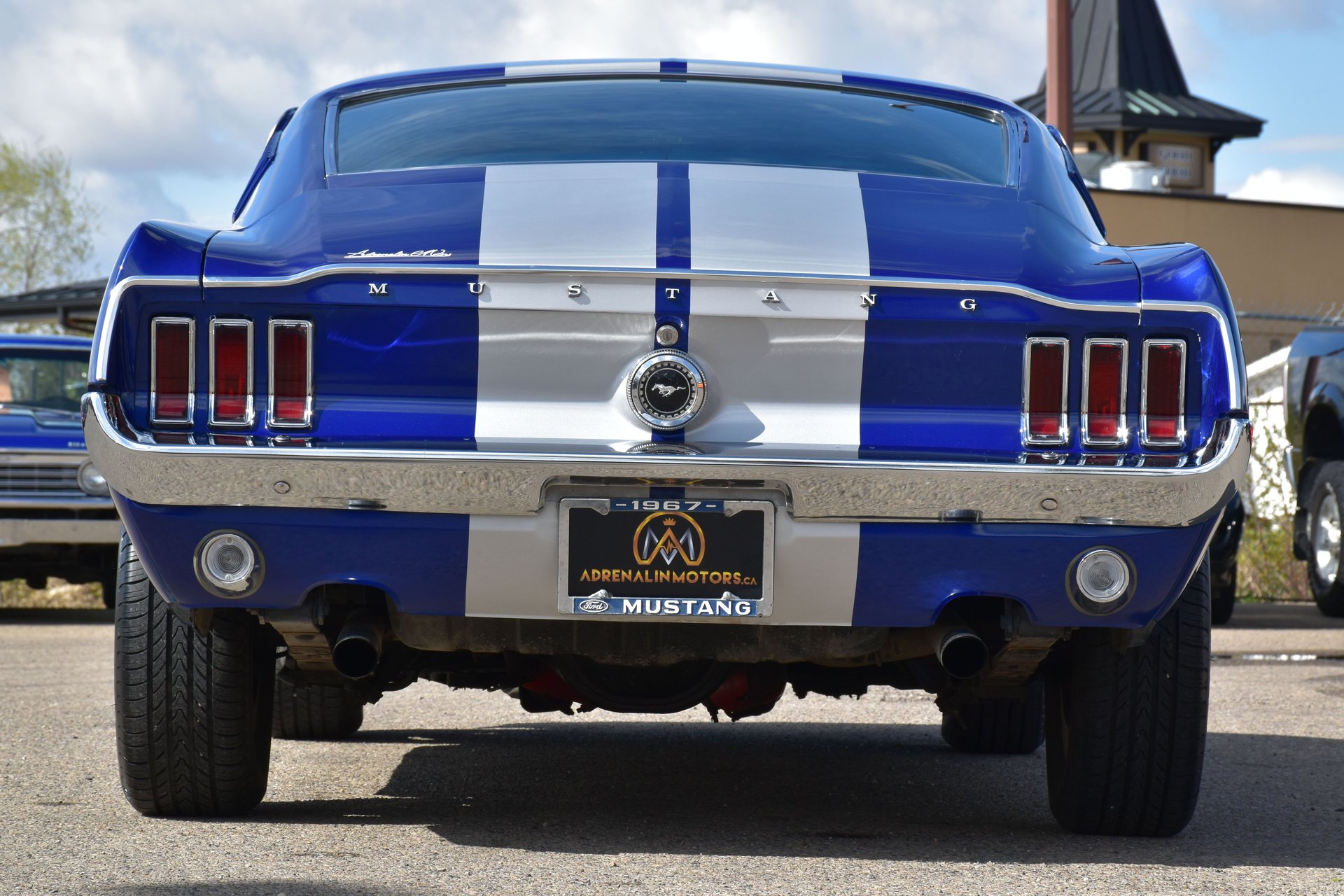
Ford unveiled the Mustang in April 1964, initially as a hardtop coupe and convertible. The fastback arrived later for the 1965 model year. Its long-hood, short-deck proportions and exceptional range of options created a new market segment. Early engines included inline-six units and small-block V8s, while the GT Equipment Group made the car a sharper road-going package.
Carroll Shelby transformed the Mustang into a more serious performance machine with the GT350 in 1965 and the big-block GT500 in 1967. Ford added the Mach 1 in 1969, alongside the competition-oriented Boss 302 and Boss 429. Larger bodies, changing safety requirements and shifting customer tastes characterized the final early-model years.
The 1970 Boss 302 helped Ford compete in Trans-Am racing. The 1969–1970 Boss 429 was developed to homologate Ford’s 429 engine for NASCAR. Both were distinctive limited-run Mustang derivatives, but they served different motorsport purposes.
428 COBRA JET – FORD’S LEGENDARY 7.0-LITER V8
Explore the 1968 NHRA victory, FE engine engineering and the differences between Cobra Jet and Super Cobra Jet.
THE ENERGY CRISIS AND MUSTANG II
A smaller car with a very different brief.
Ford introduced Mustang II for 1974 amid the fuel crisis and growing demand for compact vehicles. Related to the Pinto architecture, the car was extensively reworked and offered as a notchback and three-door hatchback. No V8 was available in the first model year: buyers chose a 2.3-liter four-cylinder or 2.8-liter V6.
A more modest 302 V8 returned in 1975. Ghia emphasized comfort, while Mach 1, Cobra II and King Cobra focused on a sportier image. Although Mustang II divided traditional muscle-car enthusiasts, it helped keep the nameplate alive in changing market conditions.
THE FOX BODY AND THE 5.0
Lightweight versatility, turbo experiments and a V8 revival.
The new Fox platform brought sharper lines, more cabin space and considerable tuning potential. The familiar Mustang GT returned in 1982, the convertible in 1983 and the sophisticated turbocharged SVO in 1984. Fuel injection and engine-management improvements gradually restored performance after the low-output years of the 1970s.
The 1987 facelift introduced a smoother front end. The understated LX 5.0 and more aggressive GT became modern American performance staples. In 1993, Ford’s Special Vehicle Team introduced the SVT Cobra and the lighter, competition-focused Cobra R.
SN95, NEW EDGE AND TERMINATOR
Modern styling and Ford’s move from pushrod to Modular V8 engines.
The rounded SN95 debuted for 1994, retaining rear-wheel drive and a thoroughly revised Fox-derived platform. Mustang GT initially kept the 5.0-liter pushrod V8; in 1996 it changed to Ford’s 4.6-liter overhead-cam Modular V8. The SVT Cobra used a higher-revving DOHC version.
The more angular New Edge styling arrived in 1999. Notable performance variants included the 2000 Cobra R with a 5.4-liter V8, the 2001 Bullitt, the 2003–2004 Mach 1 and the supercharged 2003–2004 SVT Cobra. Nicknamed Terminator, the latter was officially rated at 390 SAE hp and quickly became a tuning favorite.
S197: RETRO STYLE, MODERN PERFORMANCE
The return of classic Mustang proportions – and the Boss 302.
The S197 reinterpreted the first-generation Mustang with a new platform and squared-off, retro-inspired styling. GT models initially used a 4.6-liter three-valve V8. A substantial redesign followed for 2010, and in 2011 the GT gained the 5.0-liter Coyote V8.
Ford revived the Boss 302 for 2012–2013 with a specially developed 5.0-liter Road Runner engine, track-oriented suspension and distinctive side exhaust. The Laguna Seca variant took the circuit focus further. The same period saw powerful GT500 models, culminating in the supercharged 5.8-liter, 662 hp GT500 for 2013–2014.
S550: A WORLDWIDE MUSTANG
Independent rear suspension and a broader international audience.
The S550 Mustang introduced independent rear suspension across the range and was designed for more markets worldwide. The engine lineup included EcoBoost four-cylinder options and the evolving 5.0-liter Coyote V8. A ten-speed automatic gearbox became available following the 2018 facelift.
Performance milestones included the flat-plane-crank GT350, the supercharged GT500, a renewed Bullitt and the return of the Mach 1. Track engineering grew in importance alongside everyday usability.
S650: THE V8 ERA CONTINUES
Digital cockpit, updated styling and Dark Horse.
Ford launched the seventh generation for the 2024 model year. It retains recognizable Mustang proportions, rear-wheel drive and a V8 option while adding a redesigned interior with large integrated screens and updated driving electronics.
The Dark Horse introduced a dedicated performance specification with a revised 5.0-liter Coyote V8 and track-focused hardware. Mustang continues to bridge its muscle-car heritage with modern road and circuit performance.
MUSTANG MOTORSPORT
Explore Boss 302R, Mustang GT4, Dark Horse R, GT3 and the road-legal Mustang GTD in five separate features.
More Mustang history
Explore related articles on Boss 302, Shelby Super Snake and the broader Ford performance heritage.
This English-language overview is shorter than the Norwegian reference article, which contains additional model-by-model photographs, specifications and source material.